Skip to content
Primitive Peptides

01 / ENDOGENOUS ORIGINS

NAD+: The Molecule With No Gap At All

Identical to the endogenous compound, demonstrably raisable in human blood, and still the clearest illustration in this set that a natural molecule and a clinical outcome are separate results.

Abstract, in plain English

NAD+ stands for nicotinamide adenine dinucleotide. It is not a peptide. It is a coenzyme — a small helper molecule that enzymes need in order to work — and every living cell already makes it, uses it and rebuilds it continuously.

It does two jobs. It ferries electrons through the chemical steps that turn food into usable energy, and it is consumed as raw material by a set of enzymes that repair DNA, adjust which genes are switched on, and regulate inflammation. That second job matters here: those enzymes do not borrow NAD+, they use it up, so the cell has to keep replacing it.

The amount of NAD+ in tissue falls as people age. That single observation is the reason a supplement industry exists around two of its precursors, NMN (nicotinamide mononucleotide) and NR (nicotinamide riboside). The human trials are consistent about one thing and unsettled about another: the precursors reliably raise NAD+ in blood, and what that raise accomplishes is still an open question.

What it is

NAD+ is a dinucleotide: a nicotinamide mononucleotide unit joined to an adenosine monophosphate unit by two bridging phosphate groups, giving one pyridine nicotinamide ring and one adenine ring, molecular formula C21H27N7O14P2. The oxidised form is written NAD+ and the reduced form NADH; the pair is a redox couple, which is chemistry's way of saying it exists to pick electrons up in one place and set them down in another. Older literature calls it Coenzyme I or DPN.

It is included in a catalogue of research peptides for a reason that is worth stating openly: it is not one. It is a nucleotide-derived coenzyme, and it is grouped with peptides only because it is sold, injected and discussed in the same channels. Categorising it correctly matters, because the reasons a peptide fails to survive the gut or the bloodstream are not the reasons NAD+ fails to enter a cell intact.

In regulatory terms, NAD+ and its precursors are marketed as dietary supplements. The FDA has taken the position that NMN is excluded from the dietary-supplement definition because it was investigated first as a drug, which has left that corner of the market unsettled. Intravenous and injectable NAD+ is typically compounded rather than FDA-approved, and a compounded NAD+ injection has been the subject of a Class I recall for elevated bacterial endotoxin.

What it is

How it works

Two distinct roles run in parallel.

As a redox carrier, NAD+ moves electrons through glycolysis, the TCA cycle and oxidative phosphorylation — the pathway sequence that ends in ATP, the cell's spendable energy. In this role NAD+ is not consumed; it cycles between its oxidised and reduced forms indefinitely.

As a signalling substrate it is consumed. Three families of enzymes cleave NAD+ to do their work: the sirtuins (SIRT1 through SIRT7), NAD+-dependent deacylases that adjust gene regulation; the PARPs, chiefly PARP1, which respond to DNA damage; and the ectoenzymes CD38 and CD157. A foundational 2021 review identifies these as the major competitors for a shared NAD+ pool and frames the age-related decline in that pool as a candidate target in age-related disease [4].

The mechanistic detail that most often goes missing in marketing is that the decline is a balance problem, not merely a supply problem. CD38 activity rises with age and inflammation, so part of the fall in tissue NAD+ reflects faster consumption rather than slower production. Adding precursor addresses one side of that ledger. The other side — the enzymes drawing the pool down — is untouched by it, and the human evidence on whether the supply side alone is decisive is exactly what remains unsettled.

What the research shows

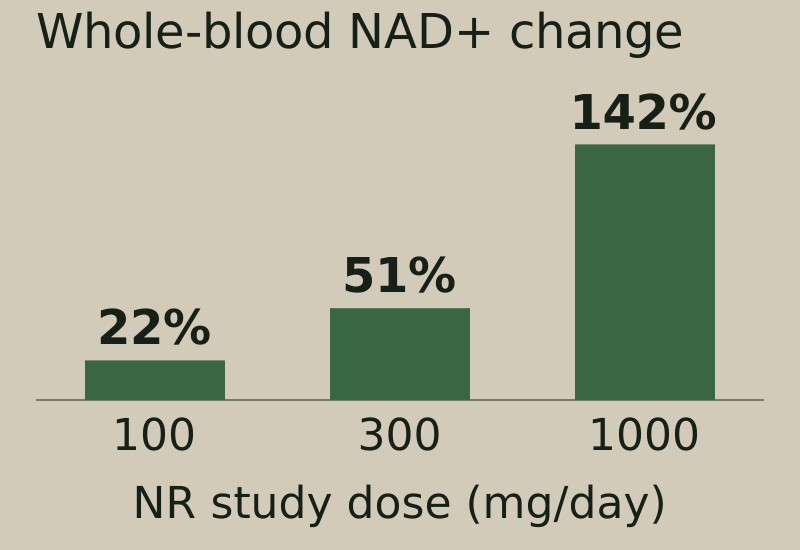
The pharmacokinetic claim is the best supported. In a randomised, double-blind, placebo-controlled trial in healthy overweight adults, nicotinamide riboside at 100 to 1000 mg per day for eight weeks raised whole-blood NAD+ dose-dependently by 22%, 51% and 142% respectively, with no flushing and no significant difference in adverse events from placebo at any dose [5]. A multicentre, double-blind, placebo-controlled trial of oral NMN at 300 to 900 mg per day for 60 days in middle-aged adults likewise raised blood NAD+ at days 30 and 60 across every dose group versus placebo, improved walking distance and quality-of-life scores, and identified 600 mg per day as the optimal dose tested, with no safety issues at any dose [2].

One trial reaches a mechanistic endpoint rather than a subjective one. Ten weeks of oral NMN at 250 mg per day improved muscle insulin sensitivity in prediabetic postmenopausal women, measured by hyperinsulinaemic-euglycaemic clamp, and remodelled insulin signalling — with no change in body composition or HbA1c [3].

Against that, the most current synthesis is cautious. A 2025 narrative review in Nature Metabolism concluded that human trials of NAD+ precursor supplementation in ageing have shown limited efficacy, that the age-related decline in NAD+ has been consistently observed in only a limited number of human studies, and that data on tissue-specific NAD+ dynamics remain sparse — arguing for more human work on systemic and tissue-level NAD+ metabolism rather than continued extrapolation from rodents [1].

Read together, the picture is unusually clean: the intermediate marker moves, reproducibly and dose-dependently, and the clinical destination has not been reached.

Documented concerns and safety context

No compiled set of community-reported effects accompanies this entry, so nothing anecdotal is presented for NAD+ on this page. What follows is drawn from the documented controversies and the regulatory record rather than from user reports.

Oral NAD+ itself is poorly taken up by cells intact, which is why precursors are generally considered the rational oral approach and why plain oral "NAD+" capsules are argued to be largely ineffective. Intravenous NAD+ wellness therapy is marketed far more aggressively than its controlled evidence supports; infused NAD+ is cleared rapidly from plasma, and infusions run too quickly are associated with chest and abdominal discomfort, flushing and nausea. Compounded injectable NAD+ carries a contamination risk that is not theoretical — the FDA has issued a Class I recall of a compounded NAD+ injection for elevated bacterial endotoxin.

A theoretical oncology concern is documented in the literature: because NAD+ supports proliferating cells, raising it could in principle support the metabolism of an existing cancer, and NAD+ in oncology has dual, context-dependent roles. Supplement-grade product quality also varies widely, and third-party testing is not guaranteed.

Much of the strongest anti-ageing data comes from rodents, and the 2025 human review named above is explicit that this extrapolation is where the field's confidence has outrun its evidence [1].

Where it fits in these origins

NAD+ is the control condition for the argument this site is built on. Everywhere else in the catalogue there is a gap to point at — a fragment standing in for a whole hormone, a cyclised analogue standing in for a native one, a topical serum standing in for wound-triggered release. Here there is no gap. The molecule supplemented is the molecule the body makes, or one step away from it, and there is no structural modification to blame.

That removes every excuse the naturalistic argument usually leans on. The compound is natural, the compound is identical, the level demonstrably rises [5][2], and the human clinical picture in ageing remains limited [1]. Whatever separates a higher blood NAD+ level from a better outcome is therefore not a question of the molecule being foreign. It is a question of where the molecule ends up, which enzymes are drawing on it, and whether the level in blood reflects the level in the tissue that matters — the precise question the 2025 review flags as under-studied [1].

The useful transfer to the rest of this catalogue is the reasoning, not the result. A compound being endogenous makes it a plausible starting point for research. It settles nothing about delivery, nothing about tissue distribution, and nothing about outcome.